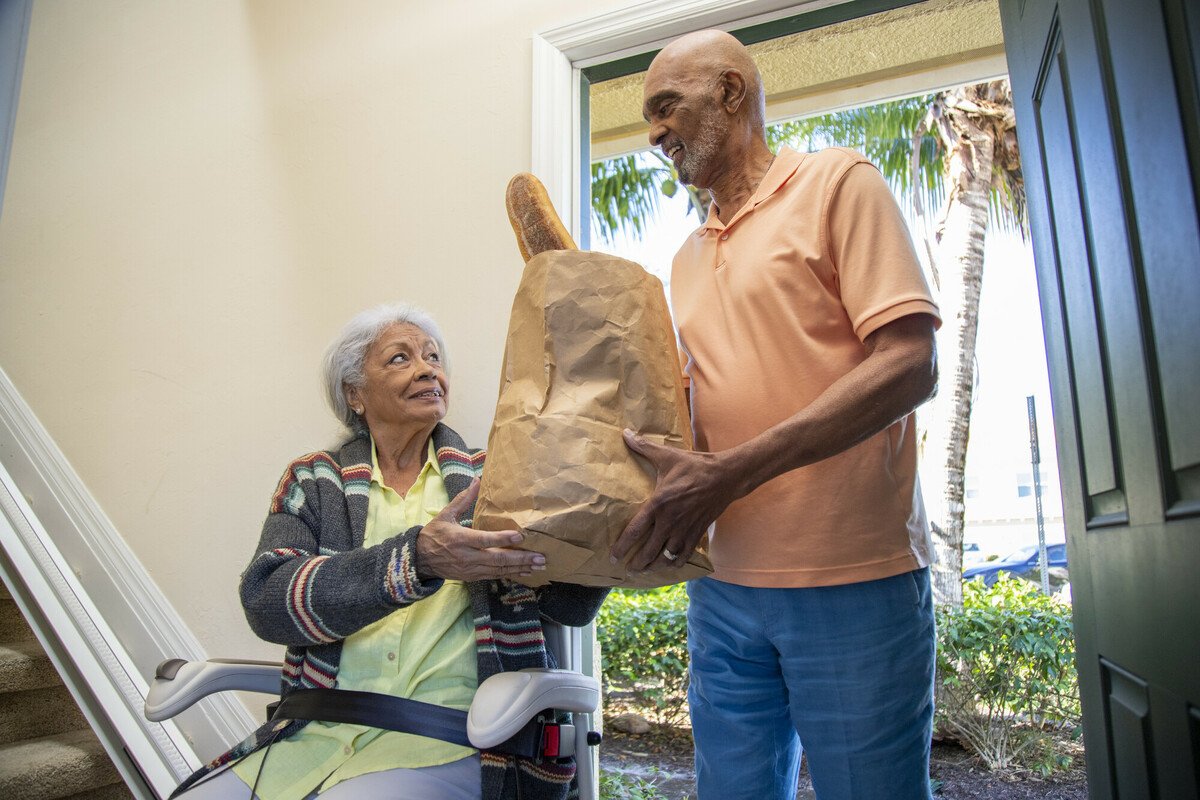
There’s no such thing as a one-size-fits-all stairlift. The right one depends on three things: your staircase, the person using it, and where it’s going.
This page walks through every common type — straight, curved, outdoor, heavy-duty, standing, and the alternatives — so you can figure out what actually fits your situation before you talk to an installer.
If you already know your staircase shape, jump to the section that matches. If you’re not sure, scroll to the end for a quick checklist.
Call us at (405) 466-5438 · Or request a free in-home quote online
Contents
- 1 1. Straight stairlifts
- 2 2. Curved stairlifts
- 3 3. Outdoor stairlifts
- 4 4. Heavy-duty stairlifts
- 5 5. Standing / perch stairlifts
- 6 6. Platform lifts and wheelchair lifts (different category)
- 7 7. Stairlift vs. home elevator — when each makes sense
- 8 How to know which type fits your staircase
- 9 Oklahoma areas we help
- 10 Not sure which type is right?
1. Straight stairlifts
Best for: staircases with a single uninterrupted run — no turns, no curves, no intermediate landings.
This is the most common stairlift in U.S. homes. About 70% of installations are straight.
A straight stairlift uses a modular rail — a pre-engineered track that’s cut to length and bolted to the stairs (not the wall). The chair rides up and down on this rail. Because the rail isn’t custom-bent, straight stairlifts are the simplest and most affordable option, and the fastest to install.
Pros:
- The simplest and most affordable option
- Fast installation (often same-day)
- Easy to remove if you sell the home
- Compatible with all major brands (Bruno, Harmar, Stannah, Acorn)
Cons:
- Only works on straight staircases
- Doesn’t work on stairs with even one turn or curved section
Oklahoma context: Straight stairlifts are common across Oklahoma — ranch-style homes in OKC suburbs like Edmond, Norman, Moore, Yukon, Mustang, and Piedmont; basement staircases in older Tulsa neighborhoods; split-level homes throughout the metro. If you live anywhere in the OKC or Tulsa metro and your staircase is a single straight run, you’re in the simplest stairlift category.
2. Curved stairlifts
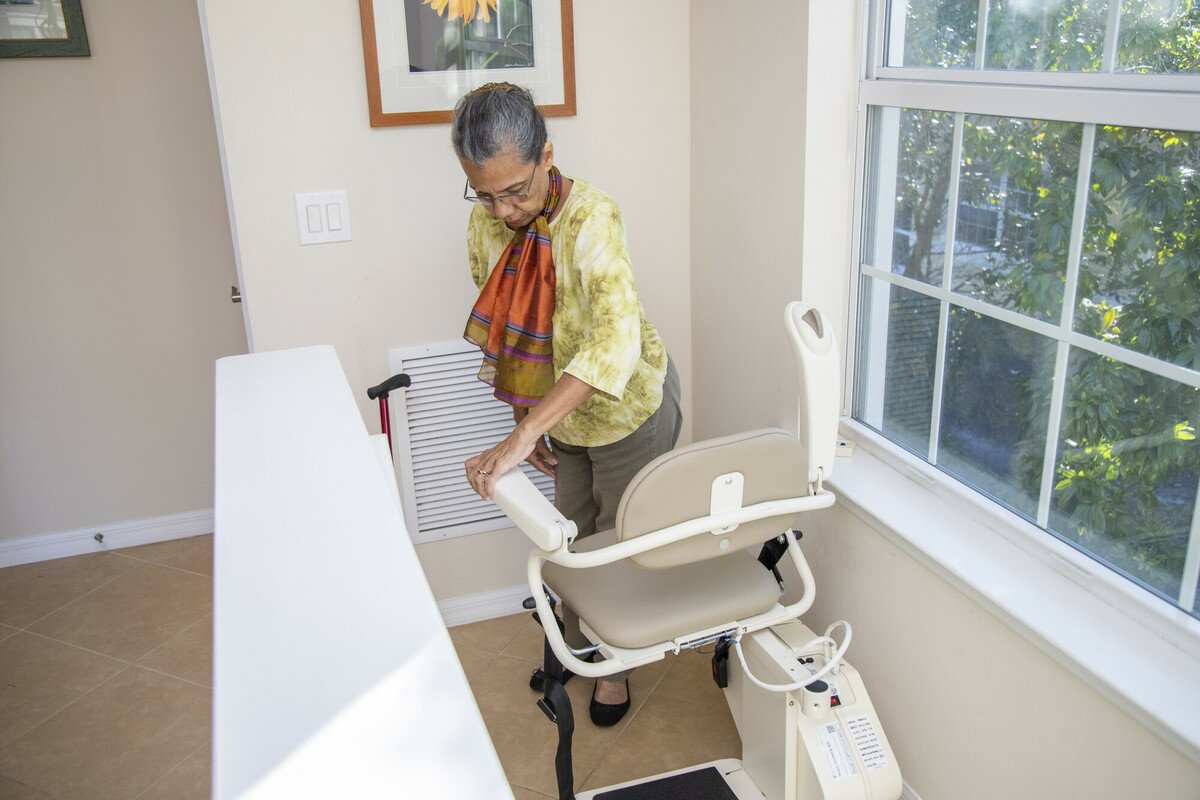
Best for: staircases with turns, curves, intermediate landings, or spiral sections.
If your staircase turns at the top, has a landing halfway up, or curves at all — you need a curved stairlift. There’s no modular option for non-straight stairs.
A curved stairlift uses a custom-bent rail built specifically to match every angle and turn of your staircase. The rail is manufactured based on precise measurements (often laser-measured during the in-home assessment) and typically arrives a few weeks after ordering.
Pros:
- Fits any staircase shape — turns, curves, spirals, multi-level
- Looks cleaner because the rail matches your stairs exactly
- Often includes a powered folding rail (folds against the wall when not in use)
Cons:
- Significantly more expensive than straight
- Longer lead time (rail has to be manufactured)
- More complex installation (typically 4–6 hours)
Oklahoma context: Curved stairlifts show up across Oklahoma — two-story homes in OKC suburbs (Edmond, Norman, Moore, Midwest City, Del City), Tulsa suburbs (Broken Arrow, Owasso, Bixby, Jenks, Sand Springs, Claremore), and growing communities like Mustang, Piedmont, and Tuttle. If your home has any turn at the top or bottom of the stairs, you’re almost certainly looking at a curved system.
→ Learn more about what affects the cost
3. Outdoor stairlifts
Best for: porch steps, deck stairs, exterior staircases leading to a side entrance.
Outdoor stairlifts look similar to indoor ones, but they’re built with weather-resistant materials: coated or anodized aluminum rails, sealed electronics, UV-resistant seats and covers, and corrosion-resistant fasteners.
In Oklahoma, outdoor stairlifts are especially relevant. We deal with all of it — summer heat that cooks unprotected equipment, ice in winter, 30+ inches of rain a year in some areas, and high humidity that rusts cheap components.
Pros:
- Lets the user access outdoor spaces, gardens, detached garages, and main entrances
- Extends the user’s independence to the whole property
- Built to last in weather — typically 10+ year lifespan
Cons:
- Costs more than indoor-rated models
- Cover recommended when not in use to extend lifespan
Oklahoma context: Outdoor stairlifts are useful across Oklahoma — raised porches in rural homes around Lawton, Ardmore, Duncan, Ada, and Shawnee; detached garages in suburbs like Yukon, Piedmont, and Newcastle; raised entryways in older Tulsa and OKC neighborhoods. Anywhere there’s an exterior staircase that someone needs to keep using, an outdoor stairlift is the practical answer.
4. Heavy-duty stairlifts
Best for: users over 300 lbs, or anyone who wants extra stability and a wider seat.
Heavy-duty (sometimes called “bariatric”) stairlifts are built with reinforced frames, wider and deeper seats, and higher weight capacities — typically 350–400 lbs vs. the standard 250–300 lbs.
Pros:
- Higher weight capacity and stronger motors
- Wider, more comfortable seat
- Often includes a powered swivel seat (rotates automatically at top and bottom) as standard
Cons:
- More expensive than standard models
- Larger seat may not fit on very narrow staircases
If the user is over 300 lbs or has balance concerns, a heavy-duty model is worth the upgrade. Most manufacturers (Bruno, Harmar) offer heavy-duty versions of their straight and curved systems.
5. Standing / perch stairlifts
Best for: users with knee issues, balance problems, or anyone who has difficulty bending to sit.
Instead of a seated chair, a perch stairlift has a small padded seat the user leans against while standing. The user faces up the stairs, holds a handlebar, and is carried up in a semi-standing position.
Pros:
- Useful for people who can’t easily bend their knees
- Smaller footprint on narrow staircases
- Easier to get on and off than a seated chair
Cons:
- Less stable than a seated model — requires the user to have decent upper-body strength and balance
- Not suitable for everyone (especially those with significant balance issues)
Standing/perch stairlifts are less common than seated models but solve a real problem for users with knee replacements, hip issues, or limited flexibility.
6. Platform lifts and wheelchair lifts (different category)
Best for: wheelchair users, or anyone whose mobility situation requires carrying a wheelchair up the stairs.
Platform lifts are different from stairlifts. Instead of a chair that rides on a rail, a platform lift has a flat surface that carries the user (in their wheelchair) up or down the stairs.
They cost more than stairlifts — typically several thousand more than even a curved stairlift — but they’re often the right solution for wheelchair users who can’t transfer to a chair.
Vertical platform lifts (sometimes called “porch lifts”) are another option for short rises — like getting from a driveway up to a porch. They’re not stairlifts, but they solve a similar problem.
If a platform lift sounds closer to what you need, an Oklahoma installer who handles both stairlifts and platform lifts can help you sort out the right option.
7. Stairlift vs. home elevator — when each makes sense
Sometimes a stairlift isn’t the right answer. Here’s a quick comparison:
| Factor | Stairlift | Home elevator |
|---|---|---|
| Cost range | Significantly less | Substantially more |
| Installation time | Hours to a few weeks | Weeks to months |
| Structural changes | Minimal — rail mounts to stairs | Significant — shaft, hoistway, electrical |
| Best for | Single staircase, one or two users | Multi-story homes, wheelchair users, future-proofing |
| Maintenance | Low — annual check | Higher — similar to a commercial elevator |
If you’re weighing stairlift vs. elevator, the deciding factors are usually budget, structural feasibility (can your home accommodate an elevator shaft?), and how long you plan to stay in the home. For most Oklahoma homeowners dealing with a single staircase, a stairlift is the practical answer. For new construction or major renovations, an elevator starts to make sense.
How to know which type fits your staircase
Quick checklist — answer these before you call an installer:
- Is your staircase a single straight run, or does it turn at any point? If it turns → curved system.
- How many steps? Length affects price on both straight and curved.
- Is the staircase indoors or outdoors? Outdoor-rated models cost more but last.
- How wide is the staircase? Narrow staircases (under 30 inches) may limit your chair options.
- Who’s using it? Their weight, height, mobility, and preferences all matter.
- Are there any obstacles? Doorways at top/bottom, low ceilings, switchback turns — all affect the install.
If you can answer those, an installer can usually tell you which system fits in 5 minutes. If you can’t, that’s what the in-home assessment is for.
Oklahoma areas we help
We help homeowners across Oklahoma find the right stairlift installer — from the major metros to smaller communities across the state.
Oklahoma City metro: Oklahoma City, Edmond, Norman, Moore, Midwest City, Del City, Yukon, Mustang, Bethany, Warr Acres, Newcastle, Piedmont, Tuttle, Choctaw, Harrah, El Reno
Tulsa metro: Tulsa, Broken Arrow, Owasso, Bixby, Jenks, Sand Springs, Claremore, Bartlesville, Glenpool, Sapulpa, Collinsville, Skiatook
Across the state: Lawton, Stillwater, Enid, Ardmore, Shawnee, Muskogee, Ponca City, Duncan, Ada, Woodward, Guymon, McAlester
Not sure if your area is covered? Call us — we’ll either connect you with a local installer or tell you honestly if service isn’t available yet.
Not sure which type is right?
Most Oklahoma homeowners don’t know exactly what they need until a specialist visits and measures their staircase. That’s what a free in-home assessment is for — no obligation, no pressure.
A specialist will:
- Measure your staircase precisely
- Ask about the user and their mobility
- Recommend a specific type and brand
- Give you a written quote on the spot or within 48 hours
Call (405) 466-5438 · Get a quote online